

You’re driving along a two-lane highway, following a river through a valley somewhere along the Lewis and Clark National Historic Trail. The scenery is beautiful, traffic is light, and you’re making good time toward your next destination. Then you spot a small brown highway sign pointing toward a historic site. You slow down, turn off the highway, and follow a gravel road to a place you might otherwise have passed without a second thought.
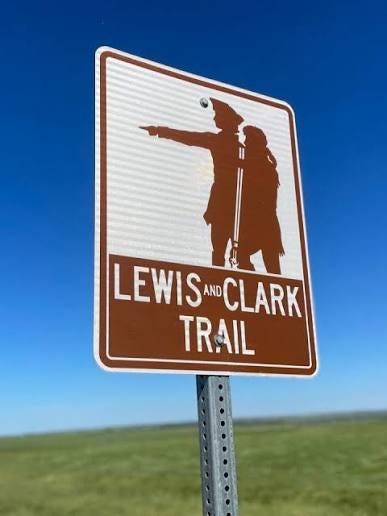
There’s a marker explaining that Lewis and Clark camped nearby. You step out of the car, look across the river, and try to imagine what this place looked like more than 200 years ago. Where did the Corps pitch their tents? What did they see when they arrived? What challenges did they face here? And what happened after they moved on?
You pull out your phone and start looking for answers.
Before long, one question leads to another. You discover a detail about the journey, then a story about one of its participants, then an event that puts the whole place into a different perspective. What was supposed to be a quick stop has turned into an hour of exploring.
Congratulations. You’ve caught the itch.
It’s that irresistible curiosity that makes some of us want to know more about the places we visit. We want to understand what happened, why it happened, and how the past shaped the world we see today. A roadside marker, an unusual bend in a river, or a small town that seems to have appeared out of nowhere can be all it takes to get us started.
If you read Undaunted Travel, I suspect you know exactly what I mean.
The good news is that you don’t have to scratch that itch alone. The Lewis & Clark Trail Alliance has some remarkable resources to help you follow the questions, discover the stories, and get more out of every mile you travel along the Trail
A Website Worth Exploring
One of my favorite places to start is Discover Lewis & Clark, the Alliance’s educational website devoted to the Expedition, its participants, and the historical circumstances surrounding their journey.

There is a lot to explore here. You can learn about the people who made the journey, the places they encountered, the challenges they faced, and the events that shaped their experiences. The site offers a depth of historical information that can turn a quick stop at a roadside marker into the beginning of a much larger discovery.
And that is the fun of it. You might begin with a simple question about a particular campsite or river crossing. Before long, you are reading about the people who were there, the decisions they made, and the circumstances that brought them to that place.
Suddenly, the landscape looks a little different.
A river is no longer just a river. It is an obstacle the Corps had to navigate. A stretch of open country is no longer simply scenery. It is a place where members of the Expedition traveled, observed, recorded, and sometimes struggled to find their way. A town or historic site becomes part of a much larger story.
That is what good historical interpretation does. It helps us see the places we visit with a better understanding of what came before us.
And while I certainly hope you continue reading Undaunted Travel, I encourage you to explore Discover Lewis & Clark, too. The two complement each other nicely: one helps you discover the history, while the other helps you find opportunities to experience it.
Meet the Man Behind the Curtain
A great deal of the credit for making these resources available belongs to Kris Townsend, who lives in eastern Washington and is a man of many talents including scholarly research and web design.
Kris is the technical talent and driving force behind the Lewis & Clark Trail Alliance’s family of websites. His work combines an appreciation for historical discovery with the technical expertise needed to organize and present a tremendous amount of information online.
In addition to maintaining and developing Discover Lewis & Clark, Kris has helped transform the Lewis and Clark Trail Experience into a comprehensive heritage tourism resource.

The two websites serve different but complementary purposes. Discover Lewis & Clark helps answer questions about the history. The Trail Experience helps you turn that knowledge into a travel experience, connecting you with destinations, attractions, communities, and other places associated with the Lewis and Clark story.
For those of us who enjoy exploring the Trail, that connection is particularly useful. We can learn about an event, discover where it happened, and then begin planning a visit to see the place for ourselves.
Building and maintaining websites of this scope takes considerable work. Historical information must be organized, presented clearly, and connected in ways that help visitors find what they need. The technology must work, the content must remain accessible, and the experience must encourage people to keep exploring.
Kris does much of that work behind the scenes. You may never meet him, but if you spend time exploring these websites, you will encounter the results of his efforts.
Your Daily Dose of Lewis and Clark
One of the real treasures on Discover Lewis & Clark is a resource called Day by Day with Lewis and Clark.
As the name suggests, it follows the Expedition chronologically, from its preparations in 1803 through the journey west, the return east, and the events surrounding the Corps’ homecoming in 1806. With more than 1,400 daily entries, it provides an unusually detailed way to follow the Expedition as it unfolded. A few entries are still being completed, but the resource already offers an impressive window into the journey.
You can explore it here: Day by Day with Lewis and Clark.
Why is a daily chronology so useful? Because it allows us to follow the Expedition as a sequence of real experiences rather than simply remembering a handful of famous milestones.
We know the broad outline of the story. Lewis and Clark assembled their party, traveled up the Missouri River, crossed the Rocky Mountains, reached the Pacific, and eventually returned to the United States.
But what happened on a particular Tuesday in May? Where was the Corps camped? What were the captains concerned about? What had happened the previous day? What challenges lay ahead?

Day by Day helps answer those questions.
You can follow the journey one date at a time, or use the calendar to investigate a particular event or location. If you are planning a visit to a place along the Trail, you can look up what the Expedition was doing in that vicinity and gain a better understanding of the historical significance of the landscape.
For history enthusiasts, it is an invitation to linger over the details. For travelers, it is a way to add context to an itinerary. And for anyone who has ever wondered what the Corps was doing on a particular day, it is a wonderful resource.
As a bonus - the Day by Day calendar contains an archive of audio features originally aired by Yellowstone Public Radio during the Lewis and Clark Bicentennial observance in 2004-2006. These 627 radio episodes parallel the expedition dates starting 14 May 1804 and ending 25 September 1806. They originally aired only on weekdays including four introductory vignettes and four episodes about events after the expedition. They are narrated by Hal Hansen, scripted by Whit Hansen and Ed Jacobson, and produced by Leni Holliman. Overall, the episodes average about 3½ minutes in length.
Bonus/Bonus - Kris is now working on new audio features to fill in the gaps of weekend and pre/post expedition narratives so there will be an audio recording to acccompany every day in the calendar.
Bonus/Bonus/Bonus - did you note the search bar? To make it easy to locate key words and phrases - Kris has thoughtfully inexed the entire site to make it easy to find the content you are looking for (or to fall into a series of rabbit holes that will consume three hours of your life.
History Doesn’t Happen in a Vacuum
Another reason Day by Day with Lewis and Clark is worth exploring is that the Expedition did not take place in isolation.
While Lewis, Clark, and the Corps of Discovery were making their way across the continent, the young United States was developing its national ambitions, dealing with international relationships, and navigating the complex realities of expansion. Indigenous nations had their own histories, political relationships, economies, and priorities, all of which shaped the world the Expedition encountered.
Understanding the broader context helps us move beyond a simple account of where the Corps traveled. It encourages us to consider why the journey mattered, what the participants understood about the world around them, and what their arrival meant to the people whose homelands they entered.
This is one of the great advantages of a well-organized historical resource. A daily entry can be the starting point for exploring a much bigger story.
That is the beauty of scratching the itch. The answer to one question often reveals three more questions worth pursuing.
Why the Source Matters
We live in an age when historical information is only a few clicks away. That is a wonderful thing, but it also presents a challenge. Not everything we encounter online is equally reliable, and a confident account is not necessarily an accurate one.
When exploring the Lewis and Clark story, I want more than an interesting anecdote. I want information grounded in historical evidence, presented in context, and organized well enough that I can follow the story and investigate it further.
That is why I recommend Discover Lewis & Clark and Day by Day with Lewis and Clark as starting points for your research.
The chronology provides a framework for understanding when events occurred and how they relate to one another. The broader educational content helps explain the people, places, and circumstances behind those events. Together, they offer a substantial foundation for learning about the Expedition.
No single website replaces original journals, archival documents, or scholarly research. Serious historical questions may require consulting those sources directly. But a carefully developed educational resource makes it easier to begin with a solid understanding of the subject and identify the next questions to ask.
And if you are planning a trip, the benefits are immediate. Knowing the story behind a place can make a visit far more rewarding than simply arriving, taking a photograph, and moving on.
From Curiosity to the Open Road
Here is how I would put these resources to work on your next Lewis and Clark adventure.
Start with a destination that interests you. Perhaps it is a historic campsite, an interpretive center, a river crossing, or a stretch of the Trail you have always wanted to explore.
Visit Discover Lewis & Clark and read about the people and events associated with that location. Then open Day by Day with Lewis and Clark and see what was happening around the date or period that interests you. You may discover a detail that changes how you think about the place.
Next, visit the Lewis and Clark Trail Experience to help identify destinations and experiences for your trip.
You now have more than a destination. You have a story to follow.
That is when history and travel come together. You are no longer just visiting a place. You are beginning to understand it.
Keep Scratching
The next time a historical marker catches your eye or a bend in the road makes you curious, follow that feeling. Ask the question. Look for the evidence. See where it takes you.
If the Lewis and Clark Expedition is your interest, Kris Townsend and the resources he helps bring to life have made that journey of discovery easier than ever.
Start with Discover Lewis & Clark. Spend some time with Day by Day with Lewis and Clark. Then use the Lewis and Clark Trail Experience to find places where you can experience the story firsthand.
And, of course, keep reading Undaunted Travel for more stories, travel ideas, and discoveries along the way.
After all, the itch is not something to cure. It is a reason to keep exploring.
Happy travels, and keep scratching!
More Resources
Lewis and Clark Trail News - our bi-weekly newsletter with Trail Happenings
Lewis and Clark Mobile App - take the Trail with you on your mobile device
Lewis & Clark Trail Alliance - learn about the work of the Alliance
Events along the Trail - our calendar of events you may wish to attend
Join The Alliance - Get involved
Additional Resources: Experience Lewis and Clark
We are grateful for the generous support of our corporate and travel partners whose sponsorship helps make this work possible. When planning your travels along the Lewis and Clark Trail, we encourage you to support the businesses and organizations that invest in preserving and sharing these stories—your patronage helps sustain both the trail and the experiences that bring its history to life.
BE CAREFUL - that itch may likely be the initial symptom of what Dayton Duncan has labeled “Lewis-and-Clark-itis.” See his introduction to his wonderful book, Scenes of Visionary Enchantment!